
TPU pocket notebook cover
I was under-challenged in high school, so to occupy myself I started writing. A letter-sized sheet of printer paper folded into quarters fit nicely in my back pocket and let me write even when I wasn't at my desk, such as during school assemblies. I never really got more sophisticated at writing on the go. I've tried pocket notebooks like Field Notes, but I struggle to mar the pristine pages with scrawled to-dos, quick math, and other jots I don't need past today, so nicer notebooks ride around in my pocket unused so long that they disintegrate. Rarely do I require several dozen blank pages, and long-term references I keep digitally, where they're backed up. Thus, a single piece of paper is most of what I need to get through the day.
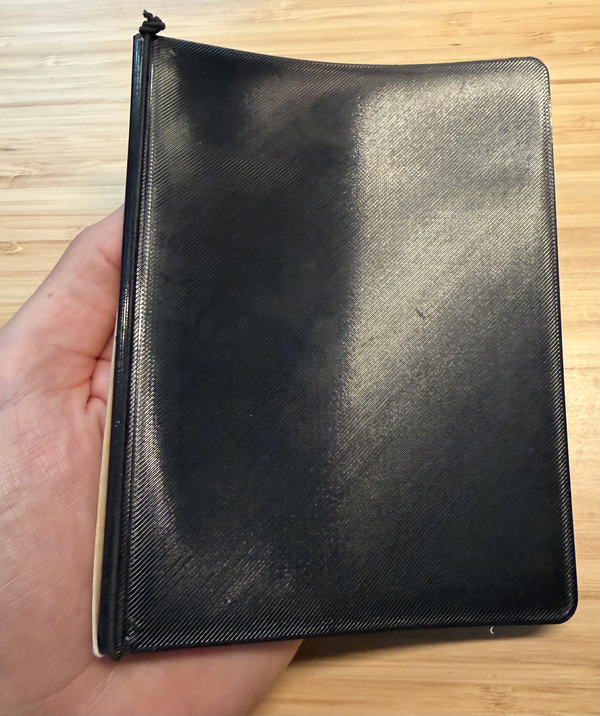
The problem, of course, is that a single piece of paper shoved repeatedly into a pocket doesn't last long enough to be filled. It gets rumpled until it's no longer nice to write on. To get some protection for such sheets, I wanted something thin and lightweight to fit in a pocket, but flexible so I wouldn't notice it. For half a year now, the job has been done by the cover part of this 3D print. It's intended to be printed with TPU, a rubber filament. After it was printed, I folded it in half and held it between two books while I used a heat gun to lock the crease into the rubber. I tried the PLA clips to hold in pages, and while they do work, they couldn't hold very many pages, and they made the cover pinch closed more than I liked, instead of staying open. I traded the clips for a traveler's journal binding: just an elastic band. It holds pages in by a fold down the middle. Shock cord works nicely, though a plain rubber band is also the right size.
Ever since those high school days, I've collected paper printed on only one side to use as scratch paper. Often I doodle an idea, or fold them into quarters and stick them in the car for when the kids demand something to draw on. Every now and then I'll riffle through the collection to find a few top or bottom halves that are mostly blank on both sides. Then I'll cut them in half, fold them, and slide the stack under the elastic band of the notebook cover. That source of paper solves the pristine problem. I have no trouble scribbling on a sheet I saved from the garbage.
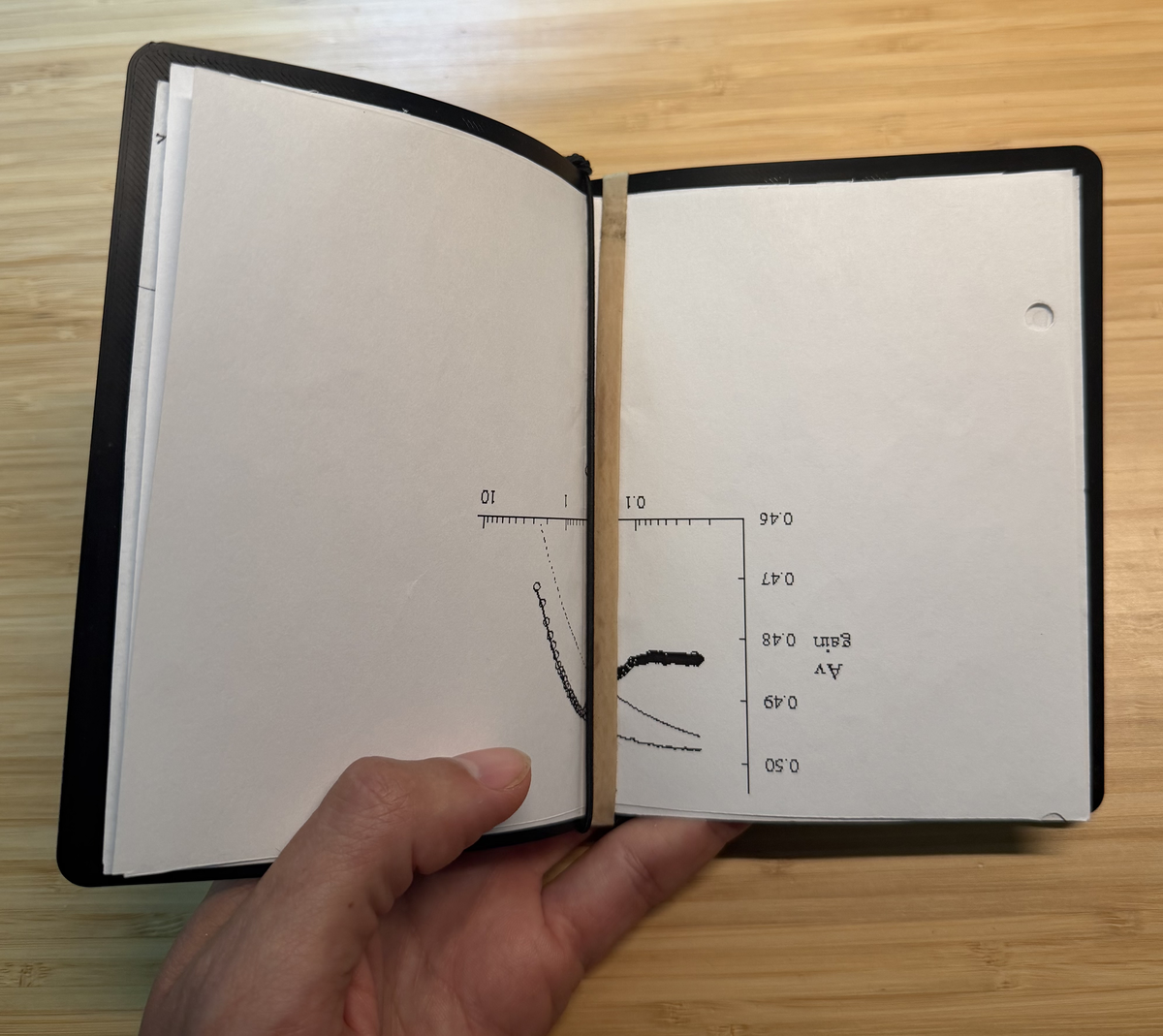
This approach also lets me decide how much paper to fill the notebook with. A few half-sheets is usually all I need until the next time I can refill it. For a long weekend with a chance to write, I add more sheets. I haven't tested the capacity. It fits more than I can typically use.
I've learned to alternate between writing in the front of the notebook and writing in the back, which fills up half sheets sooner, rather than only filling the left half of all the sheets and not being able to throw any pages away until I fill the right halves. Being able to throw sheets away prevents me from carrying around a bunch of information I've already ingested into long-term storage or otherwise addressed.
I like how thin the notebook is. It slides in and out of my pocket easily. The rubber cover is flexible, provides some protection from rain, and has so far held up to life in and out of my pockets. If you have suggestions for improvements, email me!